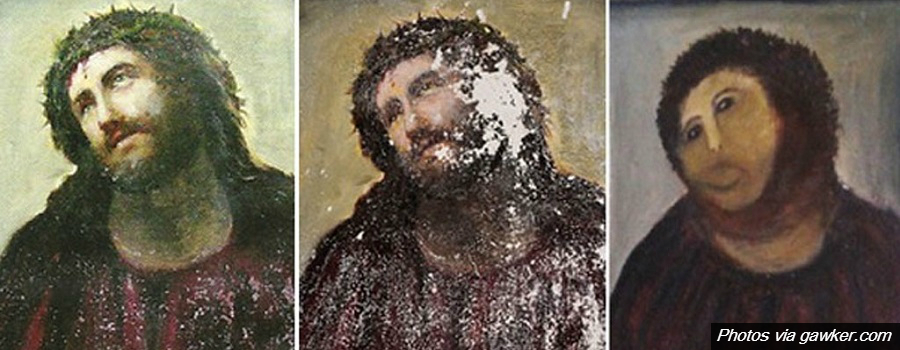
Let me start with two observations: First, it intuitively seems to be morally wrong to alter art after it has been declared finished by its artist. The infamous failed restoration attempt of Ecce Homo in 2012 is just one example. The second observation is that there seems to be a moral difference between altering AI-generated and traditional art. I hold that modifying AI-generated art is somehow morally less problematic than I would believe it to be the case for traditional art. In what follows, I will attempt to explain these intuitions and ground them in philosophical argument.
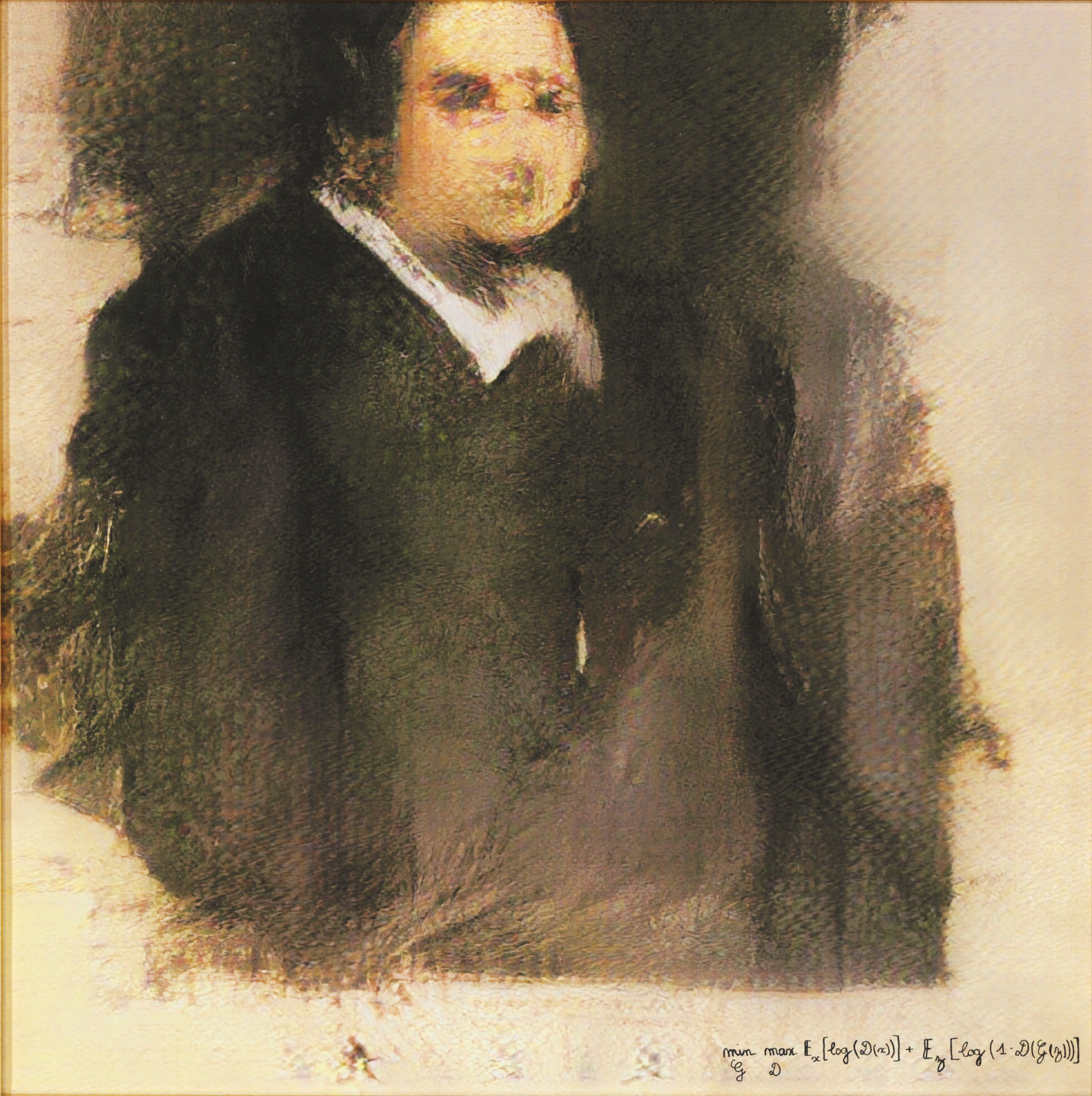
Lately, we are experiencing a certain fusion of Artificial Intelligence (AI) and the art sector as we know it. For example, the AI-generated work A.I. God, part of this triptych (on the right), was sold last year at Sotheby’s for over $1m. AI-programmes such as Midjourney, Stable Diffusion, or DALL-E 2 offer millions of users the possibility of creating something that is often astonishingly similar to traditional art, and not seldomly exhibits concepts such as beauty. But is AI-generated art really art?

To answer this question, we first need a rough understanding of generative AI. Image generating AI programmes function on a similar basis: An end user writes a prompt – a text description of the image they would like to receive. The image generating AI will then try to match this description and produce a never-before-seen image. The process in between prompt and generated image depends on a “text encoder” and an “image decoder”. The job of the text encoder is to turn the prompt given by the end user into a “transition output”. Then, the image decoder is able to decode this transition output into an image.
Now, can AI-generated images be art? Due to its strong influence in the artworld, I will rely here on Arthur C. Danto’s account.
Three concepts are important for Danto’s definition of art: meaning, embodiment, and interpretation. First, a work of art must contain meaning, which is understood as a theme, a “being about something”. While ordinary objects, such as streetlights or Brillo soap pads in a supermarket exist, we do not ponder about their meaning. For works of art, on the other hand, wondering and formulating what they mean is crucial. Second, the meaning of a work of art must be embodied. This incarnation emphasizes that meaning is more than a description, it projects a point of view and is embodied in art’s materiality – it is a sort of unity between an object and its context. Third, a viewer must interpret a piece of art. Interpretation is the contribution of those who view or engage with art – trying to grasp the embodied meaning.
Does Danto’s account allow for AI-generated images being art? Let’s start with embodiment. AI-generated images seem to successfully fulfil this criterion. After all, why should AI-generated art not be embodied? Just like traditional art, AI-generated art can be painted on canvas or printed. Therefore, I will assume that AI-generated art meets Danto’s second condition of embodiment.
What about interpretation? Here, as well, I do not see a problem. After all, people have and will continue to interpret AI-generated art. The way of interpretation for traditional and AI-generated art might be different, but I believe it must be rather an exception than a regularity if people engage with a piece of art (AI-generated or not) and do not interpret it the slightest way. Therefore, I also see Danto’s third criterion as met.
The first criterion, however, seems to be more of a challenge. Can AI-generated images be meaningful as such? (While everything can have meaning in the interpretative sense – if someone ascribes meaning to something –, not everything can have meaning sui generis – as such.)
One thing is often considered necessary for meaning: intentionality. Art must have been intended. The colourful splash of accidentally spilling paint on a street might look beautiful or interesting. However, there is no question whether it is meaningful beyond the interpretative sense: We simply do not think that something can be a work of art if it was not intended as such.
Analogously, AI-generated images may very well look beautiful or interesting, but nonetheless possess no intended meaning. AI cannot act as an intentional agent (which might include e.g. consciousness or a perspective on the world), and therefore, AI lacks intentionality.
I offer two arguments against this view. First, it does not have to be the process or the outcome of AI generation that is intentional. Instead, we can look at the input – the prompts that are intentionally created by humans. In traditional art, first, the commission of the buyer, and second, the decision of the artist to portray something a certain way determine an artwork’s meaning. In AI-generated art, the “artist” – that is, the AI-programme – lacks consciousness and cannot consciously decide how to portray something. What it does, is to picture the input, the prompt. Although the “artistic” process of AI is essentially different to traditional art-creation, I argue that the commission itself stays the same: Whether a person asks a human artist or an AI-system to portray something, the commissioner’s intention does not loose in strength in either case. Although it might be argued that – because the second step works differently – AI-generated art contains less intention than traditional art, I hold that it still does contain intention, which leads to meaning, which again leads to AI-generated art being art.
A second possibility is human editing. I argue that human intervention – such as retouching, editing, changing and shaping AI-art after it was generated by an AI-programme – does increase the amount of intentionality woven into a piece of art. The more humans are involved in an artistic process, and the more human intentions are integrated at several steps in an artistic process, the more intention does a work of art seem to contain. Further, human artists always have to work with what they are given, be it material, talent, artistic freedom, or financial independence. An AI-generated image can be seen as nothing more than a starting point – comparable to an empty canvas and untouched pencils – for human artists.
In sum, I believe that every kind of editing AI-generated art increases the amount of intentionality – which I consider already given in any AI-generated piece of art because of an intentional prompt provided by a human person.
Therefore, I conclude that on Danto’s account, AI-generated art is indeed art. It fulfils the criteria of meaning, embodiment, and interpretation.
Next, using David Fenner’s cultural memory account, I will examine the intuition that altering a finished work of art is morally wrong.
Fenner argues that certain objects, such as art, are valuable because they work as means to (cultural) memory. Unmodified art is important for four reasons: First, we value knowledge, and knowledge requires truth, and therefore, reliable memory. Second, unmodified memory is essential for prediction, because only reliable memories allow finding patterns from the past. Third and fourth, Fenner argues that memories play a key role for self-identity and shared connections. Therefore, in sum, altering completed art is morally wrong because reliable memory is vital to truth, knowledge, prediction, identity, and connection.
Combining Danto’s definition of art and Fenner’s memory-based account yields that it is morally wrong to alter traditional art (as it holds embodied meaning as a function of human interpretation or contribution). As I see AI-generated art being art on Danto’s account as well, altering AI-generated art is morally wrong for the same reasons: Only unmodified works of art serve as true testament, enable prediction, and contribute to cultural identity via cultural memory – for which cultural artifacts such as art function as key or path to.
However, this conclusion seems to contain a certain contradiction between the result that AI-generated art should not be modified after its completion, and my argumentation that exactly such a human curation or editing is important to increase intentionality – which is central for constituting meaning.
How can these results be reconciled? I will provide four reasons why I believe that there is not necessarily a contradiction between AI-generated art being art on Danto’s account and it being morally wrong to modify it on Fenner’s cultural memory account. The first possibility is to rely only on an intentional, human-written prompt to give AI-generated art intentionality and meaning. My later argument, that human curation and editing of any kind is an important tribute to increasing intentionality within AI-generated art, is to be neglected on this account. Later editing can be morally wrong, just as Fenner’s account demands, but since an intentional prompt is enough for AI-generated art to be art, this does not create a problem.
The second possibility is to argue that it is not the AI-programme itself that holds authorship in the case of AI-generated art. After all, human agents developed AI-programmes, and human agents determine the input of AI-programmes via writing intentional prompts. The second possibility ascribes authorship to the person who wrote the prompt. Then, later on editing of AI-generated art by this person is not contradictory with AI-art being art. Only later modifying by someone that is not the person who wrote the prompt is morally wrong.
A third option is to accept the tension. Next to differences in, for example, art-creating process, economic impact, or quantity and pace of art produced, there might also be morally relevant differences between traditional and AI-generated art. Fenner’s account may have been intended to mainly account for traditional art. AI-generated art, on the other hand, might constitute a special case: Whereas altering finished traditional art seems to negatively impact its value for us, the opposite could be true for AI-generated art. Human editing might turn AI-generated art more into “real” art. In this case, Fenner’s account would need to loosen its demands to allow or even encourage human editing,
Finally, a fourth possibility is to argue that in the case of AI-generated art, it is not its output that is art but the AI-programme itself. Imagine an art installation like a wind chime (for instance, Doug Aitken’s Sonic Mountain). Here, what is the piece of art is the wind chime itself and not the sounds that the wind – a rather coincidental component – creates. Another example for a similar art installation is Sun Yuan and Peng Yu’s “Can’t Help Myself”, a robot that seemingly “paints” by moving fluid. I argue that in this case as well, what constitutes the piece of art is the robot installation itself, and not the pattern of fluid produced at any point. Then, just as it is not the patterns of sound or fluid, that an art installation produces, it is not the AI-programme’s output that is the work of art. Rather, one could argue that it is the wind chime, the robotic arm, and the AI-programme itself. Such a conception would allow AI-generated art to be art on Danto’s account, and that, on Fenner’s account, subsequent altering is morally permissible. The only thing that is not to be altered in any way, because it constitutes cultural memory and identity, enables prediction and serves as true testament, is the AI-programme itself.
Thus, I can draw two conclusions: First, AI-generated art is, on Danto’s account, art. Second, it is possible to apply Fenner’s cultural memory approach without creating contradictions. Whether and in which way altering AI-generated art is morally permissible depends on which of the four offered possibilities one chooses. Either, choosing possibility one, it is morally wrong, or, choosing possibility four, it is morally permissible. Possibility two and three allow altering by either one person – the artist – or by a possibly larger group of people whose size I leave to be determined elsewhere.
Of course, other ways to solve the here encountered contradiction may wait to be discovered.
Leave a Reply